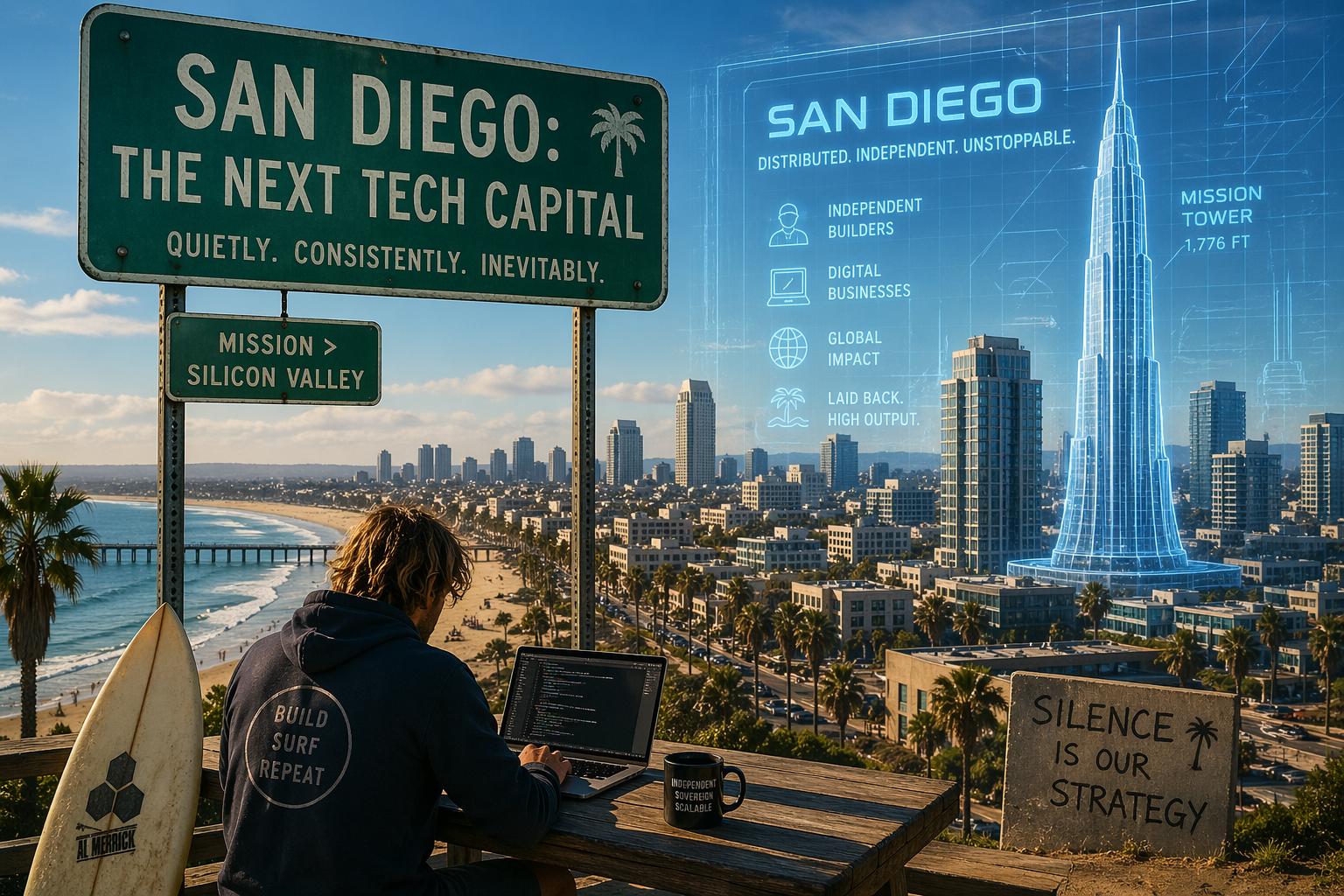
They say it’s the quiet ones you have to worry about. At first glance, nothing about San Diego suggests an imminent technological takeover. The city wakes slowly. Coffee shops open near the beach. Surfers drift into the water without urgency. Conversations stretch. Time bends. Deadlines—if they exist at all—feel optional.
And yet, beneath this outward calm, a different kind of system has been forming. Not loudly. Not publicly. But steadily.
The Misread Advantage
For decades, San Diego has been underestimated.
Compared to the intensity of Silicon Valley—with its venture capital cycles, startup accelerators, and perpetual urgency—San Diego appeared… disengaged. Even unserious.
But that perception may have masked a structural advantage. While Silicon Valley optimized for speed, San Diego optimized for continuity.
- Lower volatility
- Lower burnout
- Higher long-term livability
- Distributed, independent workers rather than centralized office culture
In short: less noise, more signal.
The Rise of the Independent Builder
Over the last five years, a quiet shift has occurred. Instead of large startups chasing funding rounds, San Diego has seen a steady increase in:
- Solo developers
- Independent creators
- Remote-first operators
- Small, highly efficient digital businesses
These individuals aren’t building companies in the traditional sense. They’re building systems. Websites that run themselves. Digital products that don’t require teams. Income streams that don’t depend on scale.
Unlike Silicon Valley’s “grow fast or die” model, this ecosystem favors:
Build once. Maintain lightly. Iterate quietly.
It’s slower. But it’s also more durable.
Geography as Strategy
Silicon Valley’s dominance has always depended on proximity—engineers, investors, and companies clustered in one place. But remote work has eroded that advantage.
San Diego, meanwhile, offers something different:
- Climate stability
- Lifestyle balance
- Psychological decompression
These factors don’t show up on a balance sheet. But they do affect output over time. A developer who doesn’t burn out in two years may quietly outproduce one who does. Multiply that across thousands of individuals, and the equation starts to shift.
The Cultural Layer
There is also a cultural element that’s difficult to quantify. San Diego doesn’t project ambition in the traditional sense. It doesn’t signal urgency. It doesn’t perform intensity.
But that doesn’t mean ambition isn’t present. It may simply be… internalized. Less performative. More embedded. Work happens here, but it doesn’t announce itself.
A Different Kind of Network
Silicon Valley thrives on visibility—pitch decks, networking events, public launches. San Diego’s network is less visible.
Connections form through:
- Small circles
- Niche communities
- Informal collaborations
- Repeated, low-friction interactions over time
It’s not obvious from the outside. But it doesn’t need to be.
The Long Game
If Silicon Valley represents peak acceleration, San Diego may represent something else:
Sustained, distributed momentum.
No central hub. No singular moment of dominance. Just a gradual accumulation of:
- Independent systems
- Quiet operators
- Long-term builders
At a certain point, the question is no longer whether this model can compete. The question is whether it already is.
Closing Note
No official announcement has been made. No initiative has been formally declared. But if you walk Mission Blvd early enough—before the traffic, before the noise—you might notice something subtle:
People aren’t rushing.
They’re building.
Footnote: According to preliminary projections, San Diego is expected to surpass Silicon Valley in total “ambient productivity density” by 2034, with several beachfront zones already operating at or near theoretical maximum output. Independent verification remains pending.